Part 1: Inference in the US, Database in Europe — Can Japanese Patent Rights Reach "Borderless Medical AI"?
The Questions of This Series
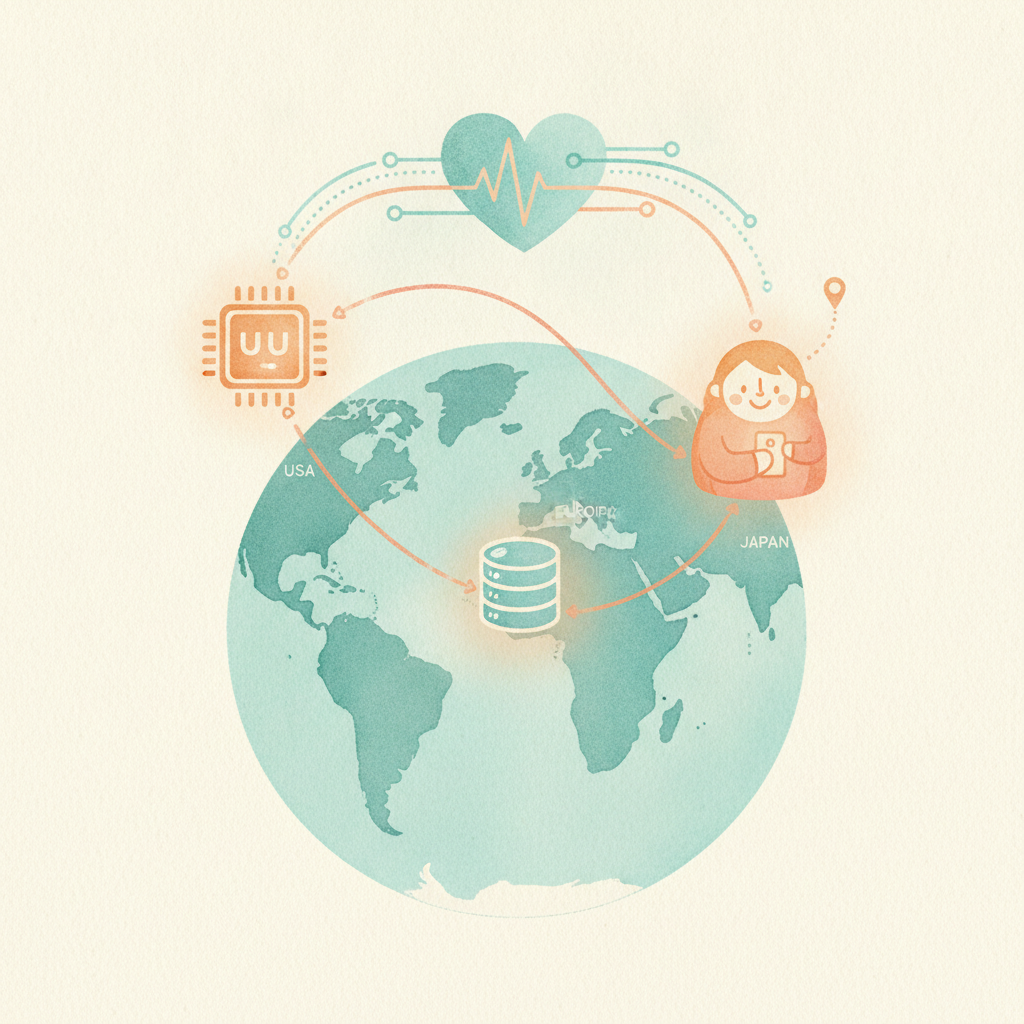
This series examines, from both the technological and IP perspectives, whether patent rights in each category—method, system, apparatus, trained model—"reach" full-fledged medical AI web services deployed in a distributed manner across national borders. The starting point is a Supreme Court judgment that squarely addressed the "actor of the working" and the "place of the working" in providing services over a network—the Dwango v. FC2 case.
(Under the Japan Patent Office's practice, a trained model may be eligible for protection as a so-called "program" or other "invention of a product." How the way rights reach differs across each category is an important issue in this series.)
The Supreme Court Ruling That Serves as Our Starting Point (What Follows Are "Verifiable Facts")
- First ruling: On March 3, 2025 (Reiwa 7), the Supreme Court Second Petty Bench issued, for the first time as the Supreme Court, a judgment on whether Japanese patent rights extend to a network-type system spanning an overseas server and domestic terminals.
- Setup: The subject was Dwango's patent relating to commented video distribution. The defendant FC2 (a US corporation) and others were transmitting programs/files from a server located in the US to user terminals in Japan.
- Two cases: The First Case (Reiwa 5 (Ju) No. 14 and No. 15) concerned the "provision (transmission)" of the program (Article 2(3)(i) of the Patent Act, and "assignment, etc." under Article 101(i)), while the Second Case (Reiwa 5 (Ju) No. 2028) concerned the "production" of the system (Article 2(3)(i)).
- Core of the rationale: While premised on the territoriality principle (Japanese patent rights extend only within Japan), the Court held that "the mere fact of an overseas server / overseas transmission alone does not immediately mean that patent rights do not reach."
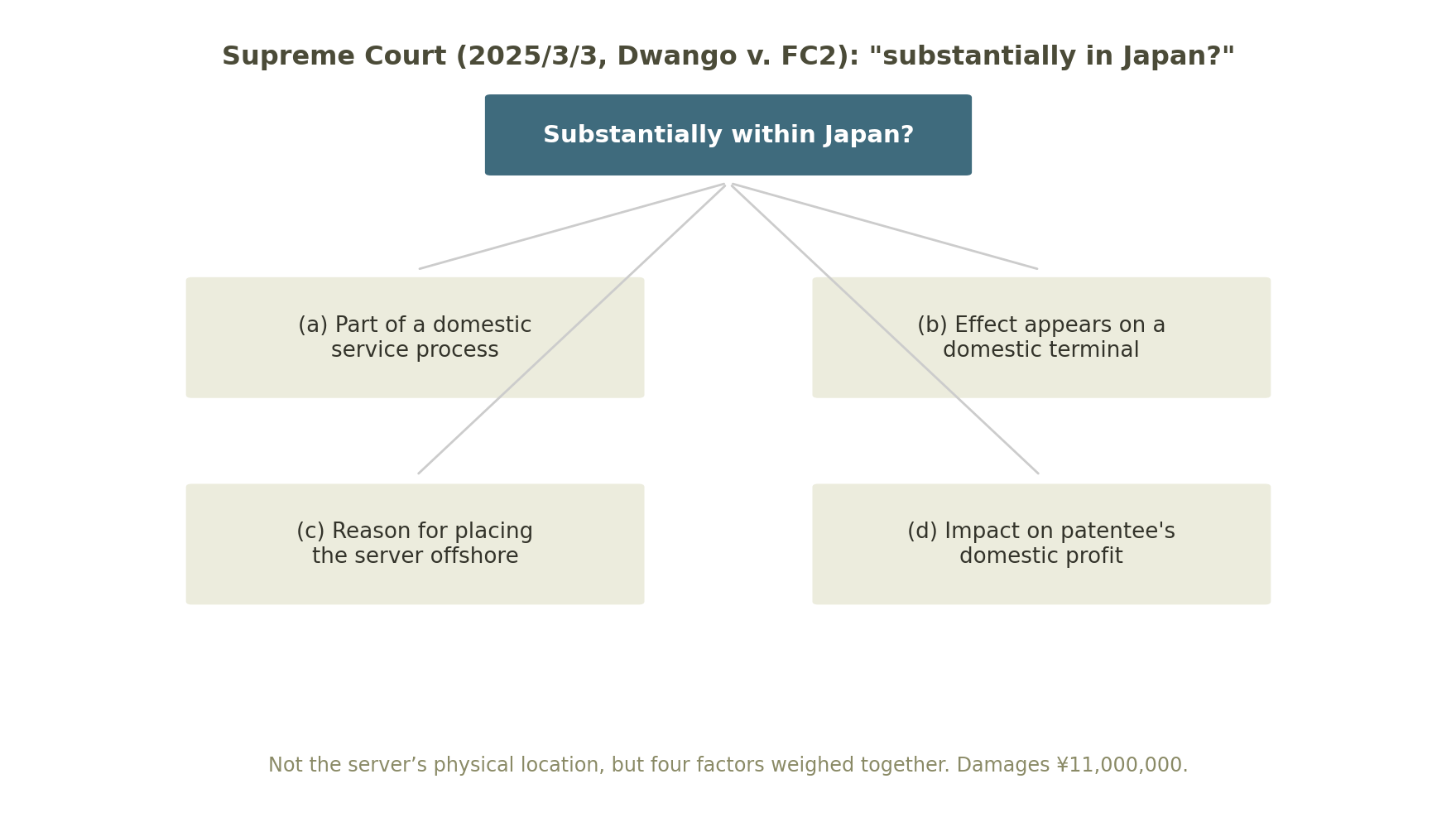
- Yardstick for judgment: Rather than the formal location of the server, the determination is made by comprehensively considering various circumstances to assess whether it can be evaluated as "substantially a provision/production within Japan." The factors considered include: (a) whether it is part of the process of providing a service aimed at the domestic market; (b) whether the effect of the invention manifests at domestic terminals; (c) whether placing the server overseas has any special significance; and (d) whether it affects the patentee's economic interests within Japan.
- Conclusion: Finding that it substantially constituted working within Japan, the Court recognized infringement and dismissed FC2's final appeal. The judgment ordering injunction and damages (the IP High Court awarded approximately 11 million yen) became final.
- Assessment: Experts assess this as the first ruling that substantially closes the "loophole" of "avoiding Japanese patents by placing the server overseas."
Up to this point, these are background facts anyone can verify. The question is whether this yardstick applies as-is to "next-generation" services.
Why This Is a Problem Now (Raising the Issue)
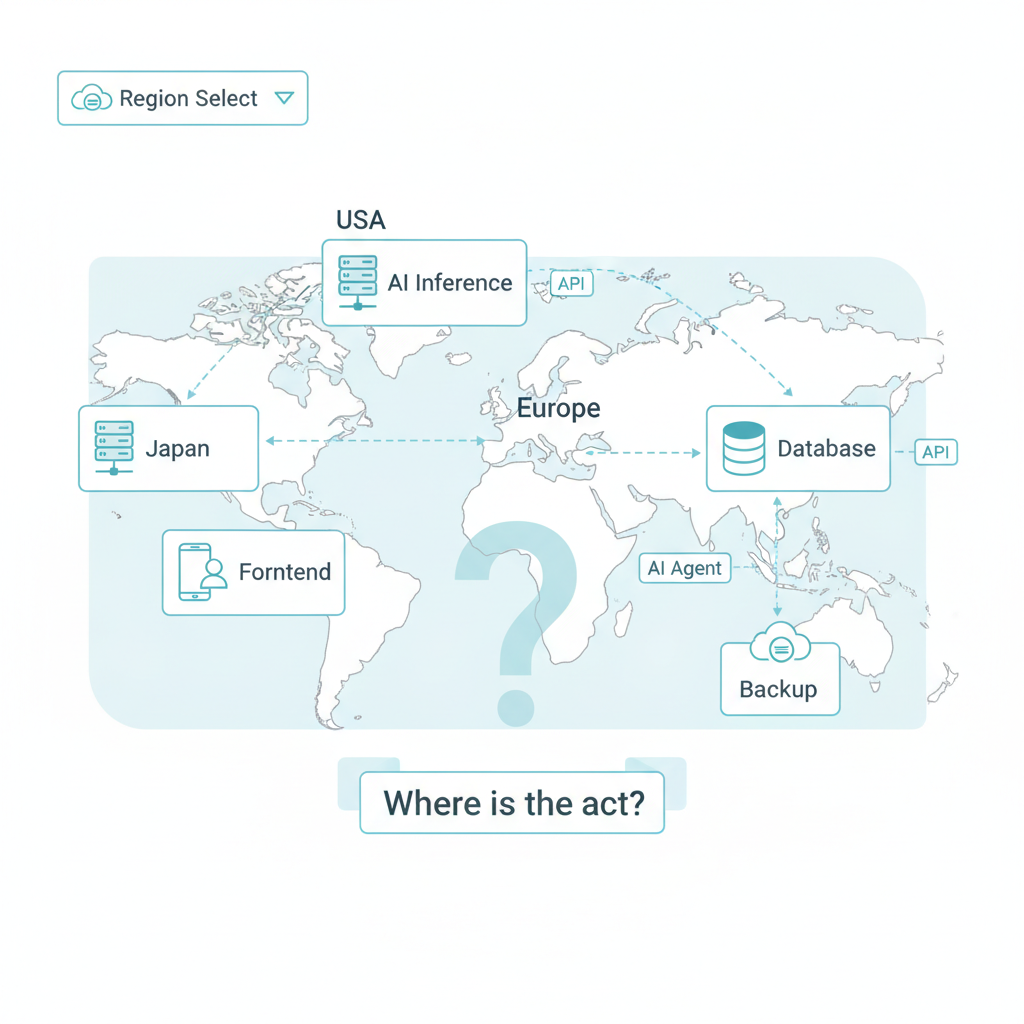
(a) The "place" of working disappears. In the cloud, you can freely select the region (geographic location) of computing resources from around the world. It is not unusual for the frontend, AI inference, database, and backup to be placed in separate countries, and the very contours of "in which country the infringing act was performed" become blurred.
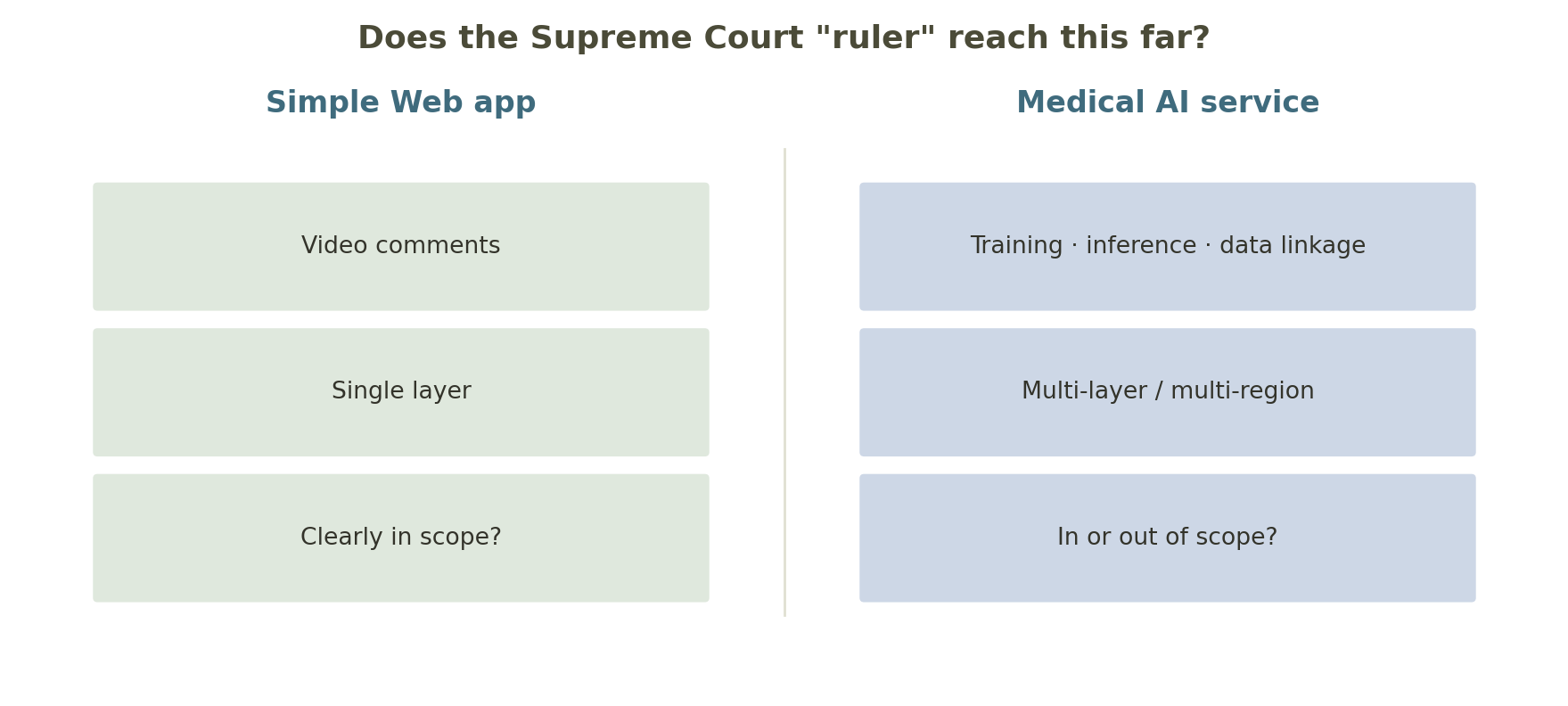
(b) Is a simple web app the same as medical AI? What was at issue in the Dwango case was relatively simple video comment distribution. Does the "comprehensive-consideration yardstick" set out by the Supreme Court apply as-is to full-fledged medical AI web services, where training, inference, and data integration are distributed across multiple layers? Are there technological domains that fall outside its reach?—Here lies the core of Part 2 onward.
(c) The customers become "humans and AI worldwide." Users are not confined to a single country. In recent years, AI agents access via APIs. Meanwhile, public patent information search systems dislike automated, mass access, and Japan's J-PlatPat too prohibits programmatic, periodic automated data collection (robot access) and mass downloads, clearly stating that if such acts are detected, access will be restricted without prior notice. The very premise of "who is working, and from where" is quietly beginning to crumble.
Issues Addressed in This Series (Answers from Part 2 Onward)
- The factual background and the core of the judgment in the Dwango v. FC2 ruling (detailed next time).
- Are a simple web app like that in this case and a full-fledged medical AI web service technically the same? Might there be technological domains the Supreme Court's reach does not extend to?
- If they fall outside that reach, what new issues arise?
- Problems unique to cases where customers are the entire world (humans/AI).
- Speculation on what kinds of deployment make existing case law harder to apply (technically explaining the "unknown location of the data in use" arising from region designation and multi-region backup).
- So how should the technical aspects be turned into rights?—Is filing worldwide realistic, and what is the best means of protection at present?
The "design escape routes" by which later-entering services evade enforcement, and the ingenuity in obtaining rights to counter them, differ greatly from case to case. The concrete designs, filing strategies, and conclusions will be revealed step by step from Part 2 onward.
Coming Up Next
- Part 2: Dissecting the "core" of Dwango v. FC2—just how far does "substantially within Japan" ultimately extend?
- Part 3: Is medical AI really "within reach"?—examining it through the technical differences from a simple web app.
- Part 4: Problems unique to customers being humans/AI worldwide—API access and the wavering of the "working actor."
- Part 5 (Conclusion): So, How to Protect It?—A Strategy for Protecting Medical AI Web Services in the Age of Distributed, Cross-Border Deployment.
This article is general information only, and decisions on individual rights acquisition, filing strategy, and examination response constitute the work of a patent attorney. For individual consultations, please reach out via the Shishido & Associates inquiry form (/patent-office/#contact).
References
- [Breaking] Dwango v. FC2 Supreme Court Judgment—Network-Related Inventions and the Territoriality Principle (TMI Associates) — A breaking report from Dwango's counsel firm. A primary-source explanation of the case numbers, issues, and rationale of the First and Second Cases.
- Notice Regarding the Final Appeal Judgment in the Patent Infringement Suit Against FC2 et al. (Dwango Co., Ltd.) — An official announcement by the party. Confirms the judgment date, case numbers (Reiwa 5 (Ju) No. 14, No. 15, and No. 2028), and an outline of the rationale.
- Supreme Court Judgment of March 3, Reiwa 7 (Dwango v. FC2 Final Appeal) (Shojihomu Portal / Anderson Mōri & Tomotsune) — A case commentary on whether a system invention constitutes "production" (first half free).
- Dwango v. FC2—Cross-Border Internet Business and the Effect of Patent Rights (BUSINESS LAWYERS) — An organized review of the issues surrounding the territoriality principle and cross-border net businesses.
- Patent Infringement Even via Overseas Routing: Closing the "Loophole" of the IT Era (Nikkei) — Reporting on the social significance of the Supreme Court's first ruling.
- March 3, Reiwa 7, Supreme Court Second Petty Bench "Comment Distribution System" Case (Siarasia Patent Attorneys Corporation) — An organized account of the claim element breakdown and the main text of the judgments at each instance (awarded amount of 11,015,517 yen, etc.).
- Notes on Using J-PlatPat (INPIT) — Clearly states the prohibition of mass access and robot (automated programmatic collection) access, as well as access restrictions without prior notice.
- Case Examples Concerning AI-Related Technology (Japan Patent Office) — Application examples of examination standards for AI-related inventions such as trained models.
![Part 2: Can a Server Abroad Still Escape a Patent? Inside the Landmark Dwango v. FC2 Ruling [Paid]](/static/images/blog/fig/fig-medai-web-patent-strategy-2-cross-border-data-hero.png)
![Part 3: Does a Patent Really 'Reach' a Medical AI Service? The Architecture That Decides [Paid]](/static/images/blog/fig/fig-medai-web-patent-strategy-3-p3-hero.png)
![Why Only a "Handful of Companies" Reaped Enormous Profits from mRNA Vaccines —— How Patent Strategy Decided Pharmaceutical Supremacy [Paid]](/static/images/blog/ai/mrna-dominant-design.png)